

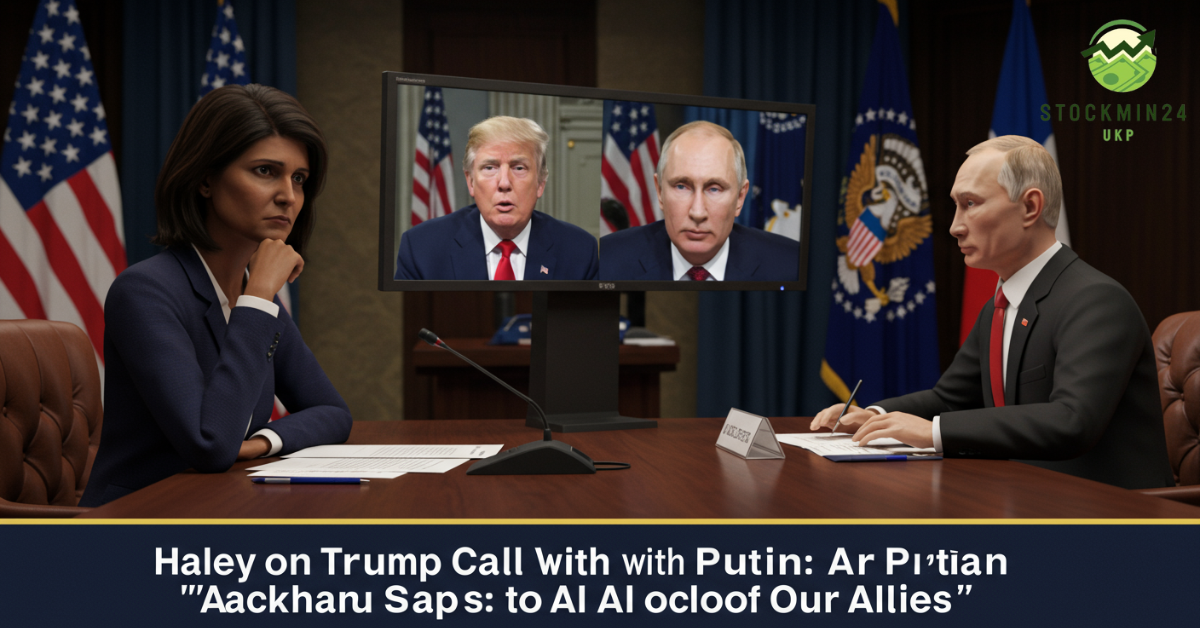
Haley on Trump Call with Putin: ‘A Backhanded Slap to All of Our Allies’
Introduction
Haley. In a political landscape already riddled with global uncertainties, former U.S. Ambassador to the United Nations and Republican presidential contender Nikki Haley has once again drawn national attention. Her recent remarks about former President Donald Trump’s call with Russian President Vladimir Putin have sparked considerable debate. Haley condemned the call as a “backhanded slap to all of our allies,” emphasizing the dangerous optics and strategic implications of Trump’s ongoing communications with authoritarian leaders, particularly in a time when U.S. allies rely on strong and consistent leadership from Washington.
This article explores the details surrounding Trump’s controversial phone call, Haley’s pointed criticism, and what it could mean for U.S. foreign policy, NATO relations, and the broader Republican Party narrative ahead of the 2024 presidential election cycle.
The Trump-Putin Call: What Happened?
Former President Donald Trump reportedly had a congratulatory call with Russian President Vladimir Putin following his pseudo-re-election victory in a vote widely regarded by international observers as rigged. The call, which Trump publicly praised as “friendly and respectful,” was met with immediate backlash not just from Democratic figures but also from within his own party.
Nikki Haley, once a close ally of Trump during her tenure as UN Ambassador, did not mince words. Speaking to reporters, she stated, “This is not how America treats its adversaries. To call and congratulate Putin after a sham election is a backhanded slap to all of our allies who are standing up to Russian aggression.”
Haley’s Criticism in Context
Haley has made it clear that she sees the United States’ international posture as one that should be firmly grounded in support for democracies and a rules-based world order. Her condemnation of Trump’s phone call underscores a broader critique of what she views as the former president’s “cozy” relationships with authoritarian figures, including Putin, North Korea’s Kim Jong-un, and China’s Xi Jinping.
Key Points of Haley’s Argument:
| Concern | Explanation |
|---|---|
| Signal to Allies | Haley argues that the call undermines NATO allies, especially those bordering Russia such as Poland, Estonia, Latvia, and Lithuania. |
| Legitimizing Authoritarianism | Congratulating Putin could be interpreted as legitimizing his leadership despite numerous human rights violations and election fraud. |
| Weakening the U.S. Global Position | Haley believes that such actions weaken America’s moral authority and global leadership. |
| Contradiction of Republican Values | Asserts that true conservatism requires strength against authoritarian regimes, not praise or appeasement. |
How Allies Reacted
European leaders—particularly in the Baltic region and Eastern Europe—have expressed concern over any gestures from U.S. leaders that appear to validate Putin’s authority. Following Trump’s call, officials in Lithuania and Ukraine reportedly expressed alarm, calling it a troubling signal at a time when European unity against Russian aggression is more crucial than ever.

| Country | Reaction |
|---|---|
| Ukraine | Called the call “insulting,” especially as they continue to face Russian military aggression. |
| Germany | Urged U.S. leadership to maintain a united front with NATO. |
| Poland | Reiterated the importance of not emboldening Putin through gestures of goodwill. |
Political Ramifications Within the GOP
Haley’s comments come at a critical time in the Republican primary race. While Trump remains a dominant force in the GOP, Haley’s challenge represents a growing divide between traditional conservatives who advocate for Reagan-era foreign policy and those embracing Trump’s “America First” agenda.
Some political analysts argue that Haley is trying to carve a path for moderate Republicans and independents who are concerned about America’s global role and the preservation of democratic norms.
The Bigger Picture: U.S. Foreign Policy at a Crossroads
This controversy is more than a political spat; it reflects a deep tension over the direction of U.S. foreign policy. The call with Putin serves as a microcosm of a broader debate:
- Should America prioritize realpolitik and pragmatic relationships even with autocrats?
- Or should it double down on its commitment to liberal democracy, human rights, and alliance-based diplomacy?

Haley’s stance leans firmly toward the latter, advocating for a foreign policy that supports democratic allies and stands firmly against authoritarian aggression.
Implications for U.S.-Russia Relations
The call also raises questions about how U.S.-Russia relations could evolve under a second Trump administration versus a Haley presidency. Trump has repeatedly expressed admiration for Putin’s “strength” and “leadership,” while Haley has consistently taken a hardline approach, backing sanctions and military support for Ukraine.
| Issue | Trump’s Approach | Haley’s Approach |
|---|---|---|
| Russia’s War in Ukraine | Questioned the extent of U.S. aid | Supports continued aid and sanctions |
| NATO | Called NATO “obsolete” | Strong supporter of NATO |
| Putin | Frequently praises him | Labels him a “thug” and “enemy of freedom” |
FAQ Table
| Question | Answer |
|---|---|
| Why did Nikki Haley criticize Trump’s call with Putin? | She viewed it as undermining America’s democratic values and disrespectful to U.S. allies. |
| What did Trump say in the call with Putin? | He reportedly congratulated Putin on his re-election in a vote considered fraudulent. |
| How did U.S. allies respond? | Many were alarmed, especially countries near Russia and those supporting Ukraine. |
| Is this criticism part of Haley’s presidential campaign strategy? | Yes, she’s differentiating herself from Trump by promoting a more traditional foreign policy. |
| Does Haley support continued U.S. aid to Ukraine? | Yes, she strongly supports helping Ukraine defend against Russian aggression. |
| How does this affect the Republican Party? | It highlights internal divisions between traditional conservatives and Trump-aligned populists. |
| What is Haley’s broader message? | That the U.S. must be strong against authoritarianism and loyal to its allies. |
Analysis: Haley’s Long-Term Strategy
Haley is clearly playing the long game. By positioning herself as the responsible conservative alternative, she aims to win over voters who are skeptical of Trump’s controversial relationships and impulsive diplomacy. Her statements reflect not just a policy disagreement, but a moral and strategic distinction that she believes defines the future of the Republican Party.
She is likely appealing to:
- National security conservatives
- Independents disillusioned by Trump
- Internationalist Republicans who value NATO and democratic alliances
Conclusion
Nikki Haley’s criticism of Donald Trump’s congratulatory call with Vladimir Putin is far more than a campaign soundbite—it’s a defining moment that crystallizes the ideological battle within the Republican Party. It exposes a sharp contrast between two visions of America’s role on the world stage: one that embraces strongman diplomacy and another that defends democratic principles and alliance-based leadership.
While Trump’s influence within the GOP remains strong, Haley’s unwavering stance may resonate with voters who are concerned about the erosion of democratic norms and America’s credibility abroad. As the 2024 election cycle heats up, the question isn’t just about who will win—it’s about what kind of leadership America wants to project to the world.
In the words of Haley: “We can’t claim to lead the free world if we’re shaking hands with tyrants.”